
Options & colours
How a patch is specified
Four decisions set the price and the look: how big, how much of it is stitched, how the edge is finished, and what goes on the back. Here is what each one means in practice.
Size
size = (width + height) ÷ 2
Patches are not priced by area. Add the width to the height and halve it — that single number is the size we quote on. A patch 8 cm wide and 12 cm tall is a 10 cm patch, and costs the same as a 10 × 10 cm square.
This is the standard method used throughout the trade. If you send a drawing without dimensions we will measure the longest points and confirm the figure with you.
Worked examples
| 5 × 5 cm | 5.0 cm · 2.0" |
|---|---|
| 8 × 5 cm | 6.5 cm · 2.6" |
| 8 × 12 cm | 10.0 cm · 3.9" |
| 10 × 10 cm | 10.0 cm · 3.9" |
| 25 × 30 cm | 27.5 cm · 10.8" |
Our range runs from about 2.5 cm to 30 cm. Above that we quote individually.
Embroidery coverage
30% — text only
Letters and an outline on a plain twill ground. The least expensive.
50% — mostly twill
Half the surface stays as twill cloth. Suits simple two-colour designs.
75% — balanced
The design covers most of the patch, twill showing through as one background colour. The usual choice.
90% — nearly full
Only a thin margin of twill left showing. Used where a full-stitch look is wanted at lower cost.
100% — fully embroidered
No twill visible anywhere. Required for flags, most police and fire insignia, and any multi-colour background.
Coverage changes the price: more stitches, more thread, more machine time. It is the single biggest factor after size and quantity.
Border
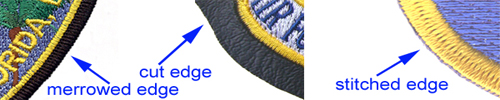
Merrowed
A raised overlock rope around the edge, about 3 mm wide. The traditional patch edge. Only possible on simple outlines — circles, shields, ovals, rectangles.
Hot cut
A heated blade seals the edge flush with the stitching. Follows any outline at all, and can go down to a 1 mm border. Use it for cut-out shapes and letters.
Stitched
A flat satin-stitch border inside the cut line. Lies flatter than merrow under a jacket seam, and works on moderately complex shapes.
Backing
Plain (no backing)
Heat-pressed flat with nothing added. Sewn on by hand or machine.
IncludedPlastic backing
A firm film pressed onto the back. Keeps the patch flat and stops the edge curling; still sewn on.
Small surchargeHeat-seal (iron-on)
A heat-seal film on the back. Press at 135–150 °C for 30–50 seconds. Not for stretch fabric or waterproof shells.
Small surchargeSelf-adhesive
Peel and stick. For temporary use: events, trade shows, sample boards.
Small surchargeHook only (single side)
Just the hard hook half, for garments that already carry a loop panel.
SurchargeHook and loop (both sides)
Both halves supplied, so one patch can move between garments.
Highest surchargeIron-on is not suitable for stretch fabric, waterproof shells or anything that will be washed above 60 °C. For training uniforms and workwear we recommend sew-on every time.
Thread colours
Nine thread colours are included in every quote. We hold 252 shades and 72 backing cloths in the office, and the whole card is online.
Send us the artwork. We will send back a proof.
No account, no obligation, no charge for the proof. Reply within one working day.